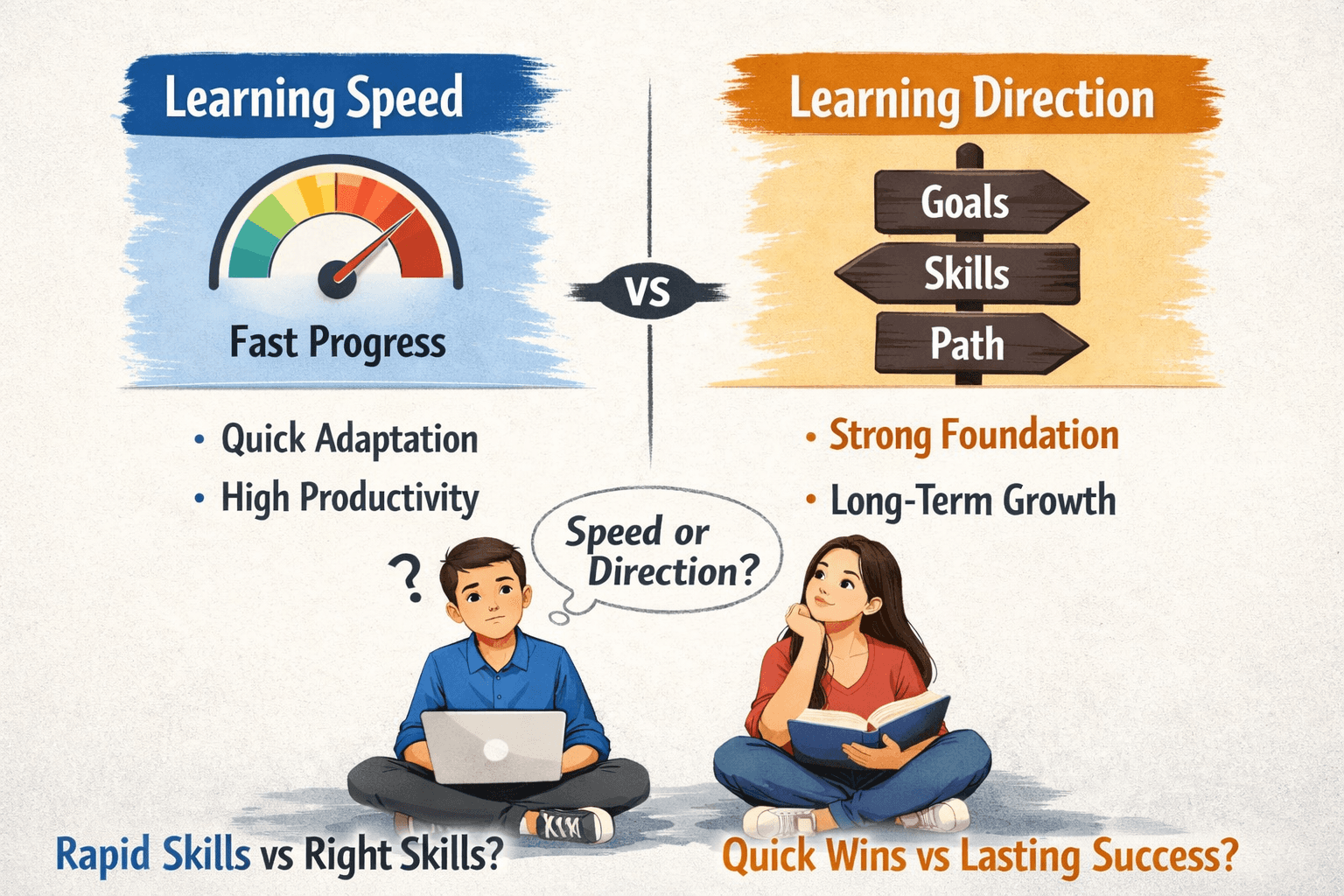
Learning Speed vs Learning Direction: What Matters More for Freshers
Introduction
Many IT freshers in India feel pressure to “learn faster.” Someone finishes a course in 10 days, another completes 200 coding questions, and it looks like speed is everything. But in real hiring—campus drives, pool campus, service companies, and product roles—direction matters more than raw speed.
Fast learning helps, but the right learning direction gets freshers hired. Understand the difference, why direction matters in Indian IT placements, and how to build a focused plan.
Learning speed vs learning direction (simple difference)
Learning speed is how quickly you consume or finish content—courses, videos, notes, problems.
Learning direction is whether what you learn is aligned to:
the roles you’re applying for
the skills companies actually assess
practical proof you can show (projects, tasks, GitHub)
A fresher can learn quickly but still feel unprepared if they are learning random topics without a plan.
Why learning direction matters more in fresher hiring
Employers repeatedly highlight that “career readiness” is not only technical. They look for competencies such as communication, teamwork, critical thinking, and problem-solving.
The World Economic Forum also points out that analytical thinking remains one of the most important core skills.
That means: even if you learn fast, if you don’t build these core signals and proof, you may still struggle to convert interviews into offers.

Common mistake: fast learning that creates “false progress”
Freshers often feel busy but don’t get results because they spend time on:
too many courses at once
advanced topics before basics
memorising answers without application
switching tech stacks repeatedly
This creates the illusion of progress, but interviews expose gaps quickly—especially when follow-up questions demand clarity and reasoning.
What the “right direction” looks like for freshers
A good direction is not complicated. It is role-aligned + proof-driven.
1) Start with “interview-safe fundamentals”
Pick one primary language and strengthen basics: logic, functions, data handling, and debugging habits. Add role-relevant fundamentals like SQL basics and APIs if those appear in most job descriptions you target.
2) Build proof, not just knowledge
Direction means your learning produces output:
one complete project you can explain end-to-end
small work samples (SQL queries, API tasks, Git commits)
documentation (README, screenshots, short notes)
3) Practice skills that hiring actually rewards
LinkedIn’s skills research consistently places communication among the most in-demand skills, along with problem-solving and other durable skills.
So direction includes learning how to:
explain your approach clearly
think step-by-step under pressure
handle “I don’t know” professionally
A simple 3-step direction plan (easy to follow)
When everything feels important, use this order:
Basics first (language + logic + core concepts)
One solid project (complete and explainable)
Interview readiness (explain, think aloud, handle unknowns)
Speed helps only after direction is correct.
How to know if your direction is right
Ask yourself these quick questions:
Can I explain my project without memorising a script?
Can I solve a new problem without immediately looking at the solution?
Can I speak my steps clearly while coding or reasoning?
Do I have 1–2 strong proofs (GitHub/project/work samples) to show?
If the answer is “not yet,” don’t panic—just correct direction and repeat.
Conclusion
For freshers, learning speed is useful, but learning direction is what converts into offers. Direction ensures your effort builds the skills employers value—analytical thinking, problem-solving, and communication—and produces proof you can demonstrate.
Start aligned, build proof, and then increase speed. That’s how preparation becomes outcomes.
Join WhatsApp Groups for Job Updates
Group 1: CLICK HERE> https://chat.whatsapp.com/KCxEwu33GbvEgwiE82BPhO
📢 Don’t forget to forward this message to your friends and help them kick-start their careers