The Reality of Pool Campus Placements for Freshers
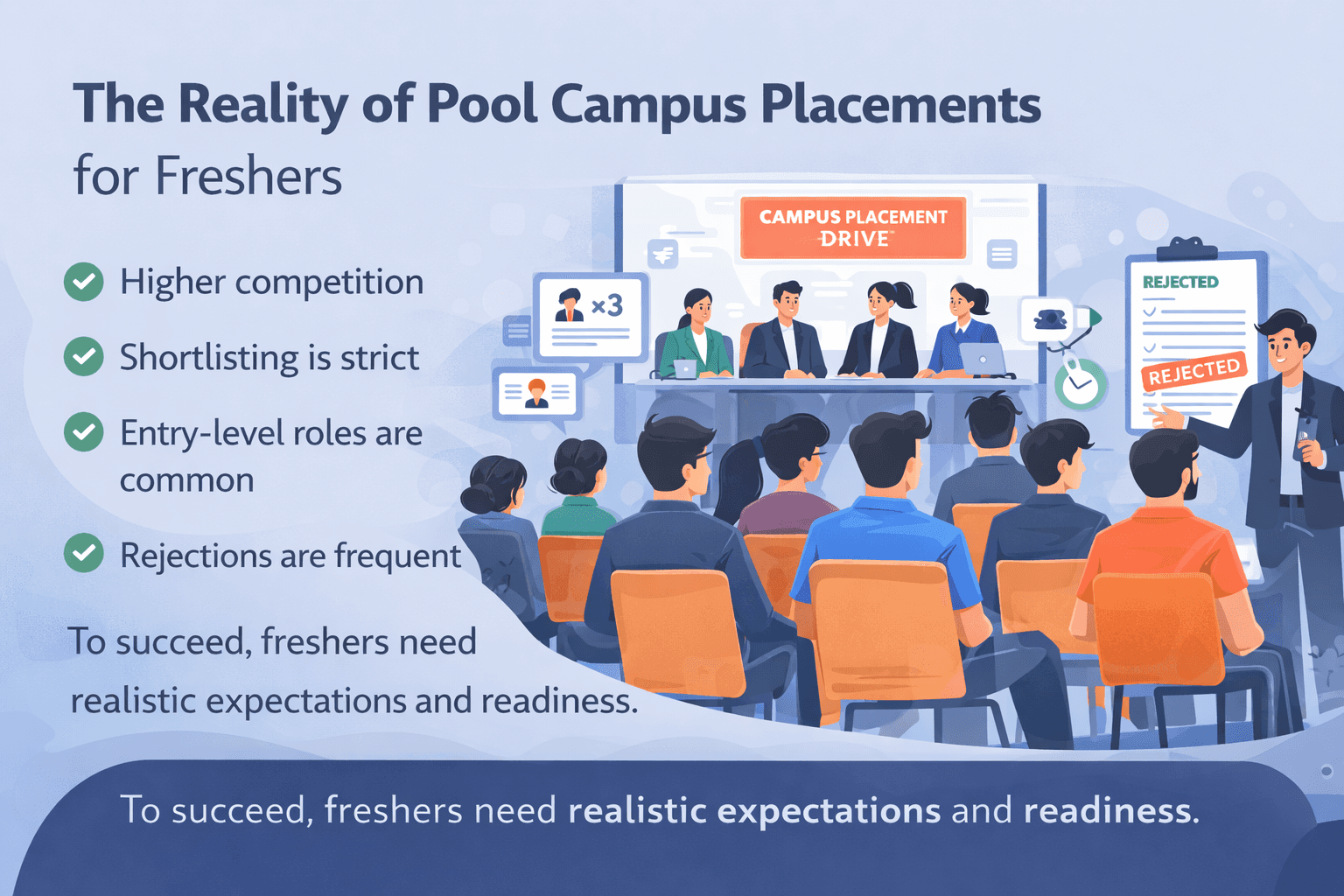
Pool campus placements sound attractive on paper. Multiple colleges, multiple companies, and the promise of more opportunities. But the ground reality is very different from expectations, and many freshers feel confused or disappointed after attending one.
Understanding how pool campus placements actually work helps you prepare better—and avoid false assumptions.
What Pool Campus Placements Really Are
In pool campus placements, one college hosts students from several nearby colleges for a single recruitment drive. Companies prefer this model because it allows them to screen a large number of candidates at once, saving time and cost.
For freshers, this means more competition in one place, not fewer opportunities.
Competition Is Much Higher Than Regular Campus Drives
In a regular campus drive, you compete mainly with your own batch.In a pool campus drive, you compete with:
students from multiple colleges
candidates with different training backgrounds
some who have already attended multiple drives
Even if a company hires 20–30 candidates, the applicant pool can be in the hundreds—or thousands.
Shortlisting Is Fast and Strict

Because of scale, companies use:
online aptitude or logical reasoning tests
proctored assessment
strict cut-offs
There is little room for “borderline” candidates. If you miss the cut-off by even a small margin, you’re out. This is why basics, logical reasoning, and accuracy matter more than memorised knowledge.
Communication and Behaviour Matter Early
In pool campus drives, interviewers don’t have time to deeply analyse every candidate. So they rely heavily on signals:
clarity of answers
confidence (not arrogance)
willingness to learn
professional behaviour
A technically decent fresher with poor communication can be rejected faster than expected.
Not All Roles Are Core or Long-Term
Another reality freshers often realise later: Many pool campus offers are for entry-level, support, or generic roles, not specialised profiles. This doesn’t make them “bad jobs,” but it does mean growth depends on how you upskill after joining.
Freshers who treat the first job as a learning platform usually benefit more than those who expect a perfect role immediately.
Rejections Are Common—and Not Personal
Getting rejected multiple times in pool campus drives is normal. It does not mean:
you are incapable
your degree is useless
your career is over
It usually means:
the cut-off was high
the role didn’t match your strengths
competition was intense
Persistence matters more than one outcome.
How Freshers Should Approach Pool Campus Placements

A realistic approach helps:
Focus on fundamentals + logical reasoning
Practice explaining answers clearly
Prepare for online assessments seriously
Treat each drive as experience, not judgment
Freshers who learn from each attempt usually perform better in later drives.
The Core Truth
Pool campus placements are not designed to find the best fresher. They are designed to find the most job-ready and low-risk fresher at scale.
If you understand this, you stop taking rejections personally—and start preparing strategically.
Final Takeaway
Pool campus placements are competitive, fast, and unforgiving—but they are also a real entry point into the IT industry. With the right expectations and preparation, they can be a stepping stone rather than a setback.