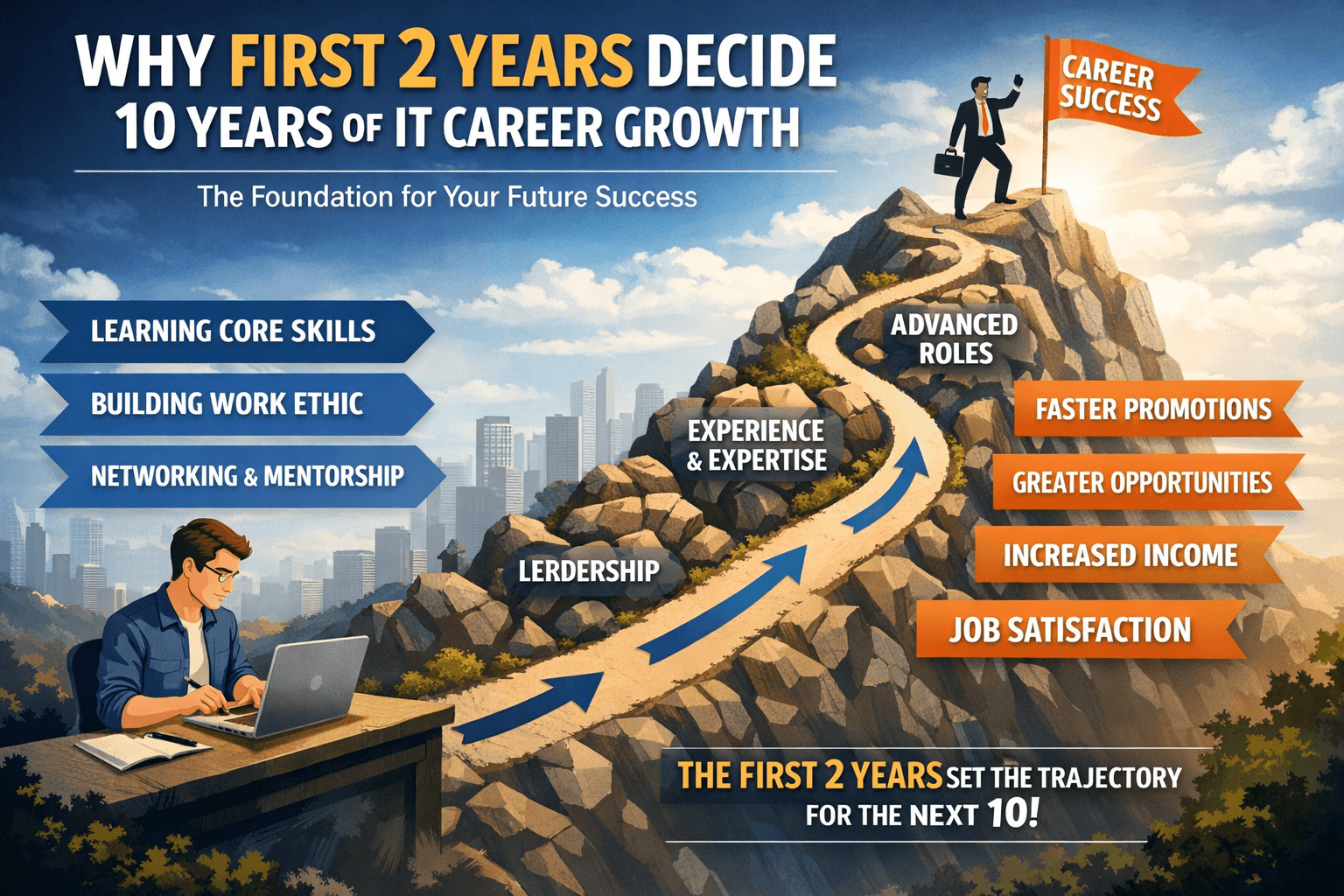
Why First 2 Years Decide 10 Years of IT Career Growth
Many freshers think the first job is only a starting point. They believe real growth will happen later, after a few promotions, better companies, or a salary jump. But in the IT industry, that is rarely how careers actually unfold.
In reality, the first two years of an IT career quietly shape the next ten.This may sound dramatic, but any experienced software engineer, tester, analyst, or architect will say the same thing that how their career took direction. Their habits, confidence, technical depth, communication style, and even future opportunities were heavily influenced by what they did in the beginning.
For engineering graduates and IT freshers in India, this is an important truth to understand early. Your first two years are not just about getting a job. They are about building the foundation that decides how fast you grow, what roles open up for you, and whether you keep moving forward or get stuck.
Why the First 2 Years Matter So Much in IT
The IT industry rewards momentum. Once you start building the right skills, work habits, and problem-solving ability, growth becomes easier. But if the early years go in the wrong direction, many people spend years trying to fix that gap later.
The first two years usually decide:
how strong your technical basics become
how you learn from real projects
how comfortable you get with deadlines and team collaboration
how quickly you become trusted with bigger responsibilities
whether you build a growth mindset or just do routine work
This is why two freshers who join around the same time can end up in completely different places after five or ten years.
One keeps learning, takes ownership, improves communication, works on real projects, and becomes promotion-ready much earlier.

The other stays busy but not truly growing. They keep doing assigned tasks, avoid learning beyond the minimum, and after a few years wonder why their career has slowed down.
That gap usually starts in the first two years.
Your early work shapes your long-term career direction
A fresher enters the industry with excitement. New laptop, new office, first salary, first project. But after the excitement settles, real career-building begins and this is where habits matter.
If you spend your first two years only completing tickets without understanding the bigger picture, you may remain dependent on instructions. But if you use the same time to understand how software is built, tested, released, maintained, and improved, you start thinking like a professional instead of just a beginner and that shift changes everything.
In IT, companies notice people who do more than assigned work. Not in a show-off way, but in a practical way. They ask better questions. They understand the task before writing code. They test properly. They communicate delays early. They care about quality. These small behaviors build a strong career identity.
And once you are known as dependable, learning-oriented, and capable, better work starts finding you.
The First 2 Years Build Technical Confidence
Most freshers focus too much on getting selected and too little on what happens after joining. But hiring is only the entry gate. Real career growth depends on what you build after entering.
The first two years are where you strengthen your technical foundation in areas like:
Programming Logic and Problem Solving
Whether you work in software development, testing, data, support, cloud, or DevOps, logical thinking matters. People who improve this early become more confident in handling complex work later.
Understanding Real Projects
College assignments and real projects are very different. In companies, you deal with bugs, deadlines, production issues, code reviews, teamwork, changing requirements, and customer expectations. The earlier you understand this environment, the faster you mature professionally.
Tools, Processes, and Team Workflow
In the IT work environment, technical growth is not only about coding. It also includes version control, documentation, Agile teams, testing practices, deployment cycles, ticketing tools, and communication with managers or clients. These are the things that make someone industry-ready.
Freshers who learn this early become valuable much faster.
The Wrong Start Can Slow Down Career Growth
Not every job automatically leads to career growth. That is an important point.
Some freshers spend two or three years in roles where learning is limited, projects are repetitive, and there is no strong mentorship. The result is that they gain experience in years, but not in actual capability.
This is why many candidates with “2 years experience” still struggle in interviews. Recruiters and hiring managers do not only look at duration. They look at quality of exposure.
Have you worked on real development tasks? Have you debugged issues? Have you understood testing, deployment, APIs, databases, or system behavior? Have you handled ownership in even a small way?
That is what creates career value.
So the first two years should not be judged only by salary or brand name. They should be judged by learning quality, project exposure, and skill growth.
What Freshers Should Focus On in the First 2 Years
To build a strong long-term IT career, freshers should focus on practical growth, not just job survival.
Learn Beyond Your Daily Task
Do your work sincerely, but do not stop there. If you are in testing, understand the product and workflow deeply. If you are in development, learn how your code affects other modules. If you are in support, understand root causes instead of just temporary fixes.
Strengthen One Core Area Properly
Build depth in one area first. It could be Java, Python, software testing, SQL, frontend, cloud basics, or automation. Strong fundamentals help you switch and grow later.It is not required to learn everything in one go.
Improve Communication Early
Many freshers ignore this, but communication plays a huge role in IT career growth. You do not need fancy English. You need clarity. Can you explain your work? Can you ask the right questions? Can you write proper updates? Can you speak confidently in meetings?
These skills improve visibility and trust.
Work on Real Projects
Practical projects matter because they connect learning to industry needs. Recruiters, managers, and trainers all know the difference between theoretical knowledge and hands-on skill. Real projects make freshers more job-ready and more confident.
Build Consistency, Not Just Motivation
Motivation comes and goes. Career growth happens through consistency. One hour of learning daily, regular practice, better discipline, and continuous improvement create a much bigger impact than random bursts of effort.
Why Skill-Based Hiring Makes This Even More Important
Across the Indian campus hiring ecosystem, skill-based hiring has become much more important. Companies want candidates who can contribute faster, adapt to tools, understand real work, and learn continuously.
That means your first two years cannot be passive.
You need structured learning, industry exposure, and practical skills that match actual job roles. Freshers who invest early in the right training, projects, and work habits often move ahead much faster than those who depend only on degree-based qualifications.
Conclusion
The first two years of an IT career may look small, but they carry long-term weight. They shape your learning speed, work habits, technical confidence, communication, and professional identity. That is why these years decide much more than your first salary. They often decide your next five to ten years.
So if you are an engineering graduate, IT fresher, or internship candidate, do not treat the beginning casually. Use it wisely. Learn deeply. Work seriously. Build practical skills. Choose growth over comfort because in IT, strong careers are not built in one big moment. They are built in the first few years, one smart decision at a time.
Join WhatsApp Groups for Job Updates
Group 1: CLICK HERE> https://chat.whatsapp.com/KCxEwu33GbvEgwiE82BPhO
📢 Don’t forget to forward this message to your friends and help them kick-start their careers