Why Freshers Fail Technical Rounds Despite Correct Answers
Introduction
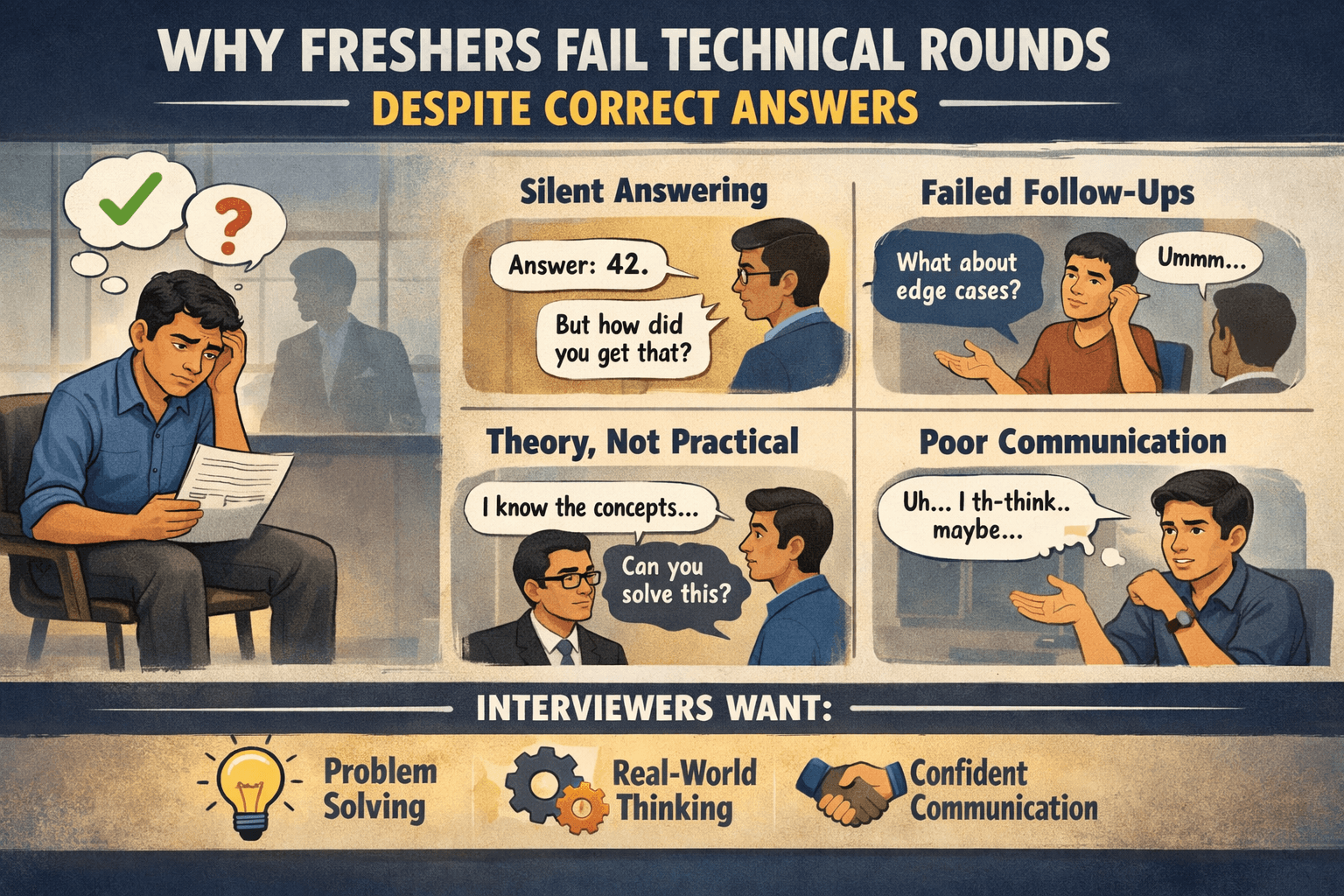
Many Indian IT freshers walk out of a technical interview thinking, “I gave the right answers—then why was I rejected?” This happens more often than people admit. In a competitive market, small differences matter. The key point is simple: technical rounds are not scored like school exams. Interviewers don’t only evaluate correctness but they also evaluate on the basis of, safe to hire, easy to train, and reliable under pressure.
What “correct answers” don’t always prove
In a real job, you won’t get perfect questions with one correct option. You’ll get unclear requirements, incomplete information, and changing constraints. So interviewers look for signals that you can handle real work: communication, reasoning, and problem-solving—skills employers consistently value.

Top reasons freshers fail despite giving correct answers
1) Your thinking is not visible
You may reach the right answer, but if you don’t explain how you got there, the interviewer can’t judge your reasoning. Many candidates answer in one line and stop. That creates doubt: Was it memorised? Was it a lucky guess?
Fix: Speak your steps briefly: problem → approach → key steps → result.
2) You collapse on follow-up questions
Freshers often prepare for direct questions. But technical rounds usually include follow-ups like:
“Why did you choose this?”
“What if the input is large?”
“What edge cases can break this?”
If you can’t handle follow-ups, interviewers assume understanding is shallow.
Fix: After answering, add one extra line: an edge case, trade-off, or complexity.
3) You know facts, but you can’t apply them
You may know definitions (OOP, SQL JOINs, API basics), but interviews test application:
“Design a simple flow.”
“Debug this logic.”
“Explain how you would handle errors.”
Employers prioritize communication and critical thinking/problem-solving in early-career hiring.
Fix: Practice small applied tasks, not only theory and MCQs.
4) Your project knowledge sounds rehearsed
Many freshers repeat project explanations like a script. Interviewers test ownership by asking:
“What broke?”
“What did you fix?”
“What would you improve?”
If you can’t answer, they assume you followed a tutorial or played a minor role—even if the project is real.
Fix: Prepare 3 proof points: your role, one challenge, one fix.
5) You handle “I don’t know” poorly
Most candidates lose marks not for not knowing, but for freezing, guessing blindly, or giving up. Companies hire freshers for potential—so they watch how you behave under uncertainty.
Fix: Use a structured response: acknowledge → relate → plan → verify.
6) Communication and confidence signals are weak
Communication is consistently ranked as a top in-demand skill, and it strongly influences how technical ability is perceived.
If you speak unclearly, rush, or sound unsure, interviewers may rate you lower even when your answer is correct.
Fix: Slow down, use simple words, and keep answers structured.
What to do before your next technical round
Practice explaining solutions out loud (even 15 minutes daily).
Solve problems without hints, then write a 3-line explanation.
Strengthen fundamentals and add edge cases + complexity habit
Turn your project into “proof stories” (role, issue, fix).
Train a calm response for unknown questions.
Conclusion
Freshers often fail technical rounds despite correct answers because interviews measure more than correctness. They measure clarity, depth, reasoning, and real-world readiness—the skills employers say they value most.
Correct answers help you. Clear thinking gets you hired.
Join WhatsApp Groups for Job Updates
Group 1: CLICK HERE> https://chat.whatsapp.com/KCxEwu33GbvEgwiE82BPhO
📢 Don’t forget to forward this message to your friends and help them kick-start their careers