Why Fundamentals Still Matter Even When Using AI
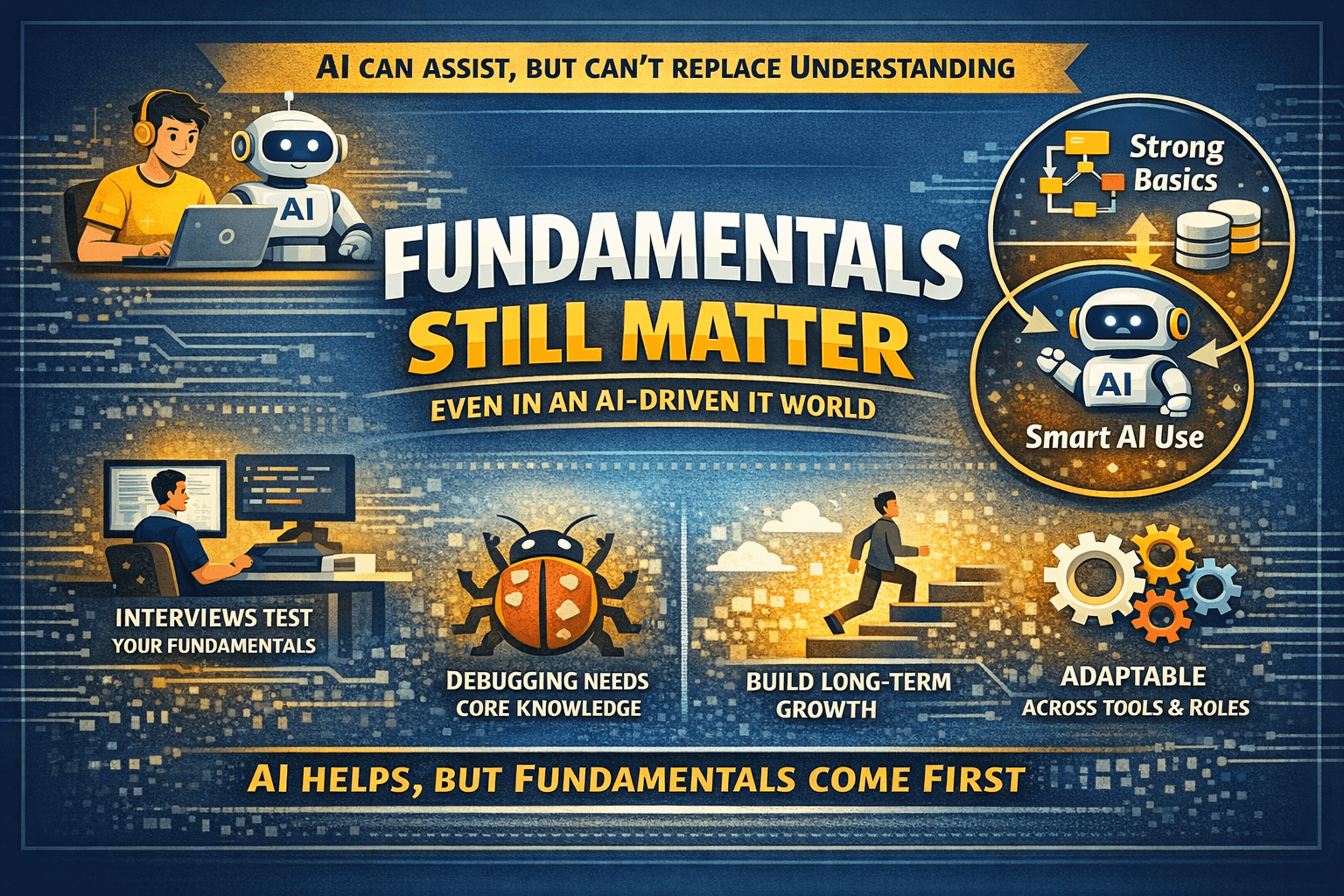
AI tools have become a regular part of the IT workplace. Freshers today use AI for writing code, fixing errors, generating test cases, and even understanding new concepts. This has created a common question among IT graduates: If AI can help so much, do fundamentals still matter?
The short and honest answer is yes. In fact, fundamentals matter more now than ever before.
AI can assist, but it cannot replace understanding. Freshers who rely only on AI without strong basics often struggle during real project work, reviews, and appraisals. In the Indian IT job market, companies still hire and promote people based on how well they think, not just how fast they generate answers.
AI should be seen as an assistant, not as a substitute for human thinking.
It generates responses by identifying patterns from past data, but it does not truly grasp your project’s real-world context, business logic, or technical constraints. When an issue arises, AI cannot take ownership or explain decisions—the responsibility always lies with the developer.
For freshers who lack strong basics in programming logic, data structures, databases, or system flow, this becomes a serious risk. Without foundational understanding, it is difficult to judge whether an AI-generated solution is correct, efficient, or even safe to use. Such gaps are quickly noticed by managers during code reviews, discussions, and project evaluations, and they often affect trust and performance ratings.
Strong fundamentals allow you to verify, modify, and explain AI-generated output confidently.

Fundamentals help you debug when AI fails
AI suggestions are not always accurate. Sometimes they are outdated, inefficient, or unsuitable for your system.
In real projects, bugs do not come with clear error messages. You need to trace logic, understand flow, check data handling, and reason step by step. This is where fundamentals like loops, conditions, memory usage, SQL basics, and API understanding become critical.
Freshers who know the basics can fix problems faster than those who only copy AI-generated code.
Interviews and appraisals still test fundamentals
Despite AI usage, interviews in India still focus on fundamentals. Companies ask about:
Programming logic
Database concepts
Operating system basics
Problem-solving approach
Even during appraisals, managers judge how well you understand your own work. If you cannot explain why a solution works, it affects trust and growth opportunities.
AI can help you prepare, but it cannot sit in the interview or appraisal meeting for you.
Fundamentals make you adaptable across tools and roles
AI tools will change. Programming languages, frameworks, and platforms will also evolve. Fundamentals remain stable.
A fresher with strong basics can easily move from one tool to another. They can learn new frameworks faster and adapt to different projects. Without fundamentals, every change feels overwhelming, and dependence on AI increases.
Companies value employees who can grow with changing technology, not those locked into one tool.
Overdependence on AI can slow long-term growth
AI makes things faster in the short term. But overdependence can weaken thinking skills over time.
Freshers who skip fundamentals often struggle when assigned ownership or asked to design solutions. They may complete tasks, but they do not build confidence. This directly affects promotions, role expansion, and leadership opportunities.
Managers prefer freshers who show independent thinking, even if they make small mistakes.
How freshers should use AI the right way
AI works best when paired with strong basics. Use AI to:
Understand concepts after trying on your own
Speed up routine tasks
Get alternative approaches
Improve documentation and clarity
But always ask yourself:
Do I understand this solution?
Can I explain it to my manager?
Can I debug it without AI?
If the answer is no, go back to the fundamentals.
Final thoughts
AI is a powerful assistant, not a shortcut to success. In the Indian IT industry, fundamentals remain the foundation of strong careers. Freshers who invest time in understanding basics build confidence, earn trust, and grow faster—even in an AI-driven workplace.
Those who combine solid fundamentals with smart use of AI will always stay ahead.