Data Science Skills Required for Freshers to Get Hired
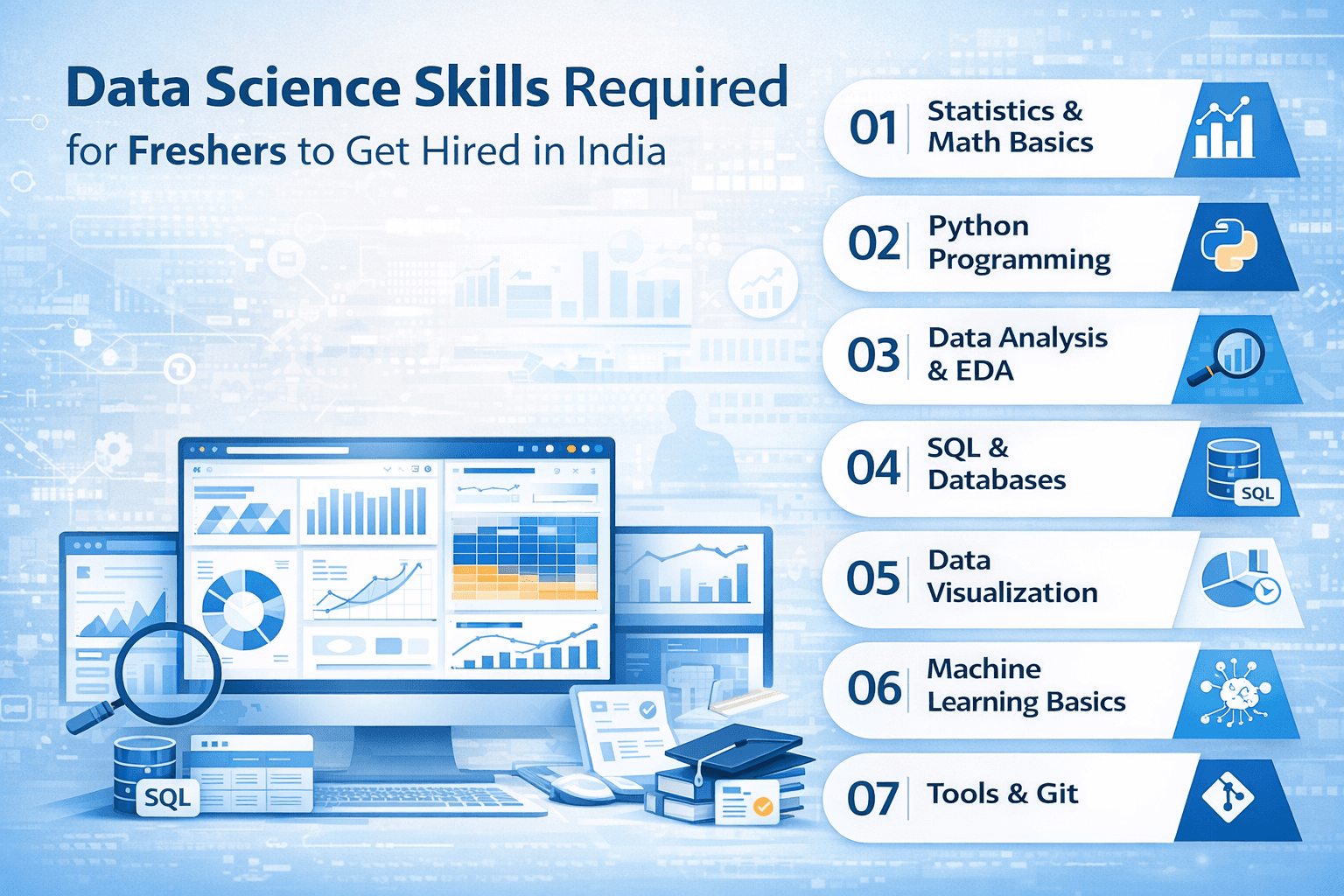
For Indian engineering students, data science has emerged as one of the most appealing career options. Entry-level data analysts and junior data scientists are in constant demand from IT services firms, analytics firms, and product-based organisations.
Many freshers do not understand what companies really want. Companies are not looking for smart experts who have just graduated. What they really want from graduates is that they have a good understanding of the basics, they can actually do things and they know how to work with data. Fresh graduates should know that companies want to hire candidates with fundamentals and practical skills and the ability to work with data is very important for fresh graduates.
This article tells you what skills in Data Science are really important for new people to get a job. It is based on what companies in India are actually looking for when they hire a Data scientist, what they look for in campus placements and what they want for entry level jobs.
Understanding Entry-Level Data Science Roles in India
For freshers, Data Science usually have below roles :
Data Analyst
Junior Data Scientist
Business Analyst (Data-focused)
Analytics Associate
These roles mainly focus on working with data, looking at it closely and figuring out what it means. They do not involve machine learning research. Knowing this information helps fresher to get ready for these data roles.
What are the core data science skills that companies expect from freshers?
1. Strong Foundation in Mathematics and Statistics
Statistics is the backbone of Data Science.
Freshers should understand:
Mean, median, mode, variance, standard deviation
Probability basics
Correlation and data distribution
Hypothesis testing (conceptual level)
Recruiters do not expect advanced mathematics, but they do expect candidates to analyze the data logically and explain trends using statistical reasoning.
2. Programming Skills (Python Preferred)
Python is the most widely used language for Data Science roles in India.
Freshers should know:
Python basics (loops, functions, lists, dictionaries)
Data handling with Pandas
Numerical computing with NumPy
The focus is on writing clean, readable code and solving simple data problems, not on complex algorithms.

3. Data Analysis and Data Handling Skills
This is one of the most critical hiring skills.
Freshers should be comfortable with:
Data cleaning (handling missing or incorrect data)
Data transformation
Exploratory Data Analysis (EDA)
Recruiters value candidates who can convert raw data into meaningful insights, even using simple techniques.
4. SQL and Database Knowledge
Almost all Data Science roles involve working with databases.
Freshers must know:
Writing basic SQL queries
Filtering, sorting, and aggregating data
Understanding tables and relationships
SQL is often tested during interviews, and many companies consider it a non-negotiable skill for analytics roles.
5. Data Visualization and Storytelling
Data is useful only when it can be explained clearly.
Freshers should learn:
Visualization tools like Matplotlib, Seaborn, or basic Tableau
How to present trends, comparisons, and patterns
Converting analysis into simple business insights
Recruiters look for candidates who can explain data in simple language, not just create charts.
6. Basics of Machine Learning (Awareness Level)
For entry-level roles, machine learning knowledge should be introductory, not advanced.
Freshers should understand:
What machine learning is
Difference between supervised and unsupervised learning
Common algorithms like linear regression and decision trees (conceptual)
Practical exposure is a bonus, but deep ML expertise is not expected from freshers.
7. Tools, Version Control, and Work Practices
Industry readiness matters.
Freshers should be aware of:
Git and GitHub for version control
Jupyter Notebook
Basic project documentation
Agile workflow concepts
These skills show that the candidate understands real-world working environments.
Step-by-Step Learning Timeline for Freshers
Month 1–2
Statistics basics
Python fundamentals
Excel basics for data handling
Month 3–4
Pandas and NumPy
SQL queries
Data cleaning and EDA
Month 5
Data visualization
Introductory machine learning concepts
Month 6
Projects
GitHub portfolio
Interview preparation
This timeline matches what many Indian training programs and campus hiring cycles follow.
Project-Based Learning Path (Very Important)
When it comes to getting a job, projects are really important. They are more important than having certificates. People who do the hiring like to see what you can actually do. That is where your projects come in. They show what you are capable of. That is what matters. So having projects is more important than just having certificates.
Freshers should work on:
Sales data analysis project
Customer churn analysis
Simple predictive model (e.g., price prediction)
Data visualization dashboard
Each project should focus on problem statement, approach, insights, and results, not just code.
Common Mistakes Freshers Make
Learning advanced ML without mastering basics
Ignoring statistics and SQL
Copying projects without understanding them
Overloading resumes with tools but lacking clarity
Not practicing data interpretation and communication
Avoiding these mistakes significantly improves hiring chances.
Job-Readiness Checklist for Data Science Freshers
Before applying for jobs, ask yourself:
Can I analyze a dataset end-to-end?
Can I write basic SQL queries confidently?
Can I explain insights clearly?
Do I have at least 2–3 genuine projects?
Is my GitHub profile updated?
Can I explain my thought process in interviews?
If the answer is “yes” to most, you are job-ready.
Final Thoughts
For Indian IT freshers, getting hired in Data Science is less about buzzwords and more about solid fundamentals and practical skills. Companies value candidates who can work with data, think logically, and communicate insights clearly.
Focus on learning step by step, build meaningful projects, and stay consistent. Data Science is a marathon, not a short race — and the right preparation makes all the difference.
Join WhatsApp Groups for Job Updates
Group 1: CLICK HERE> https://chat.whatsapp.com/KCxEwu33GbvEgwiE82BPhO
📢 Don’t forget to forward this message to your friends and help them kick-start their careers