Java Developer Skills Required for Freshers in IT Companies
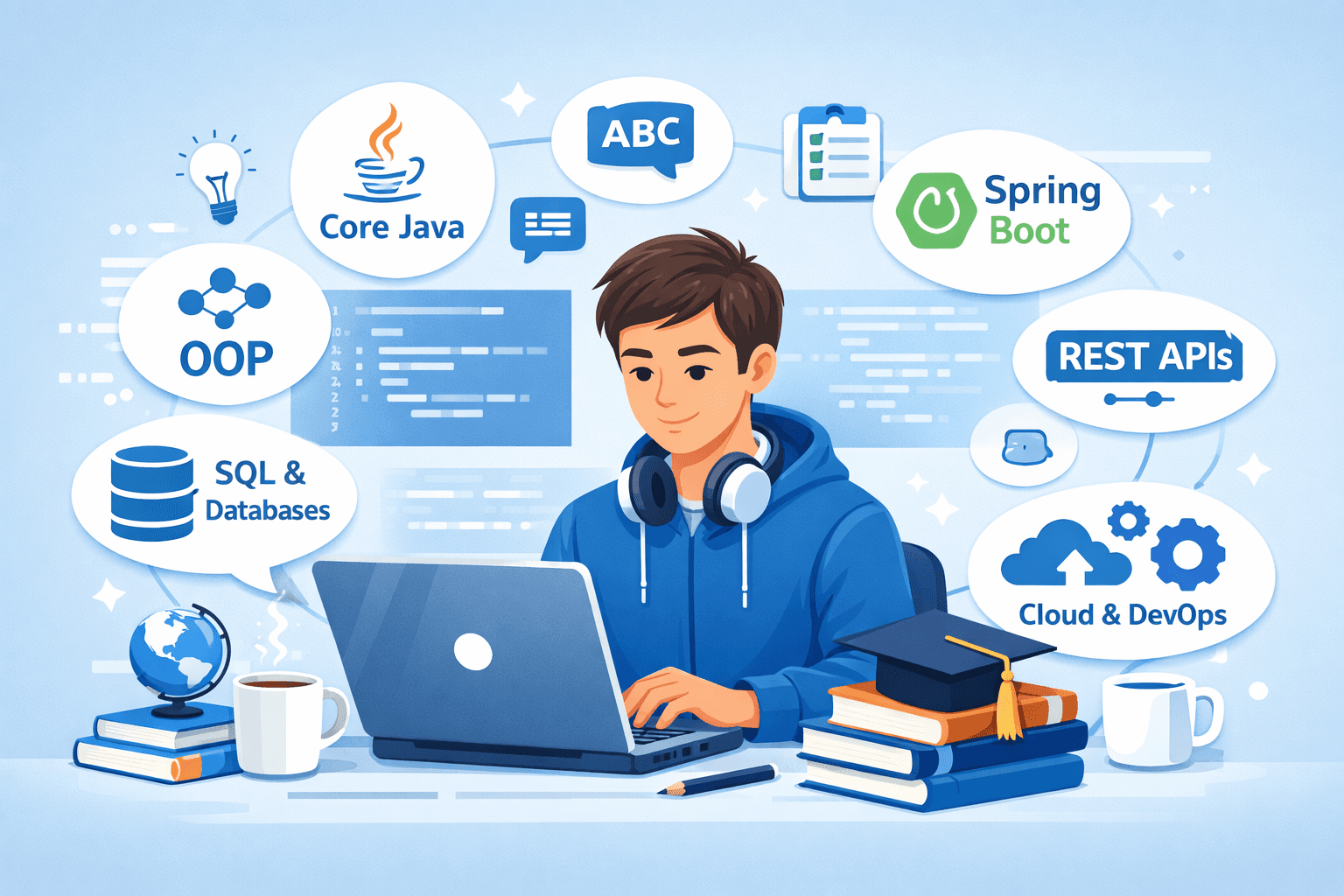
Java Developer Skills Required for Freshers in IT Companies
What Is Java Development?
Java is a high-level, object-oriented programming language owned by Oracle. Java development involves writing Java code to build applications that are:
Platform-independent (can run on Windows, Linux, macOS, etc.)
Secure and scalable
Used by millions of companies worldwide
The core principle behind Java is “Write Once, Run Anywhere (WORA)”, meaning Java applications can run on any system that has the Java Virtual Machine (JVM).
What Does a Java Developer Do?
A Java developer is responsible for:
Writing and maintaining Java code
Designing application logic using Object-Oriented Programming (OOP)
Developing backend services and APIs
Working with databases
Debugging and fixing issues
Collaborating with teams using agile methods
Skills required to be a Java Developer
1. Core Java Fundamentals
Core Java is the foundation of every Java developer role. Recruiters expect freshers to clearly understand:
Object-Oriented Programming (OOP) concepts
Classes, objects, inheritance, polymorphism, and interfaces
Exception handling
Collections framework (List, Set, Map)
Basic multithreading concepts (awareness level)
Companies do not expect freshers to be experts, but they do expect clear understanding and correct usage of these concepts during interviews and coding tests.
2. Problem-Solving and Logical Thinking
Java developers are hired not just to write code, but to solve problems using code. Freshers should be able to:
Break problems into smaller steps
Write clean and logical solutions
Explain their thought process clearly
Most Java interviews test logic through simple coding problems rather than complex algorithms. Logical thinking is often valued more than speed.
3. Backend Development Basics
Most fresher Java roles are backend-focused. Companies expect basic knowledge of:
How backend applications work
Request–response flow
Simple REST APIs
Understanding how Java handles business logic
You are not expected to design large systems, but you should know how Java is used in real applications, not just in theory.
4. SQL and Database Knowledge
Almost every Java application works with a database. This makes SQL a mandatory skill for freshers.
Recruiters expect:
Writing basic SQL queries
Using SELECT, WHERE, GROUP BY, and JOIN
Understanding tables and relationships
Many freshers lose job opportunities because they focus only on Java and ignore SQL.
5. Familiarity with Development Tools
IT companies prefer freshers who understand basic tools used in real projects, such as:
IDEs like IntelliJ IDEA or Eclipse
Git and GitHub for version control
JDK and basic build tools awareness
These skills show that the fresher can adapt quickly to a professional development environment.
6. Understanding of Basic Frameworks (Awareness Level)

While deep expertise is not expected, freshers should have basic awareness of:
Spring or Spring Boot (what it is used for)
How frameworks simplify Java development
Knowing the purpose of these frameworks helps freshers understand how Java projects are built in real companies.
7. Practical Project Experience
Projects are extremely important for Java freshers. Recruiters prefer candidates who can demonstrate what they have built.
Good beginner-level projects include:
Student or employee management systems
CRUD-based Java applications
Simple backend applications with database integration
Projects prove that you can apply your knowledge, not just talk about it.
Conclusion: What Employers Look For
In today’s IT landscape, freshers are expected to know more than just basic Java syntax. Companies want candidates who understand frameworks like Spring, can work with databases and APIs, and know how to use development tools. Add soft skills and practical experience, and you significantly increase your chances of getting hired.
Investing time in expanding your skill set — from core Java to real project work — is what will help you thrive as a Java developer in competitive IT job markets.
Join WhatsApp Groups for Job Updates
Group 1: CLICK HERE> https://chat.whatsapp.com/KCxEwu33GbvEgwiE82BPhO
📢 Don’t forget to forward this message to your friends and help them kick-start their careers