How Companies Detect Copy-Paste or AI Usage in Tests
How Companies Detect Copy-Paste or AI Usage in Tests
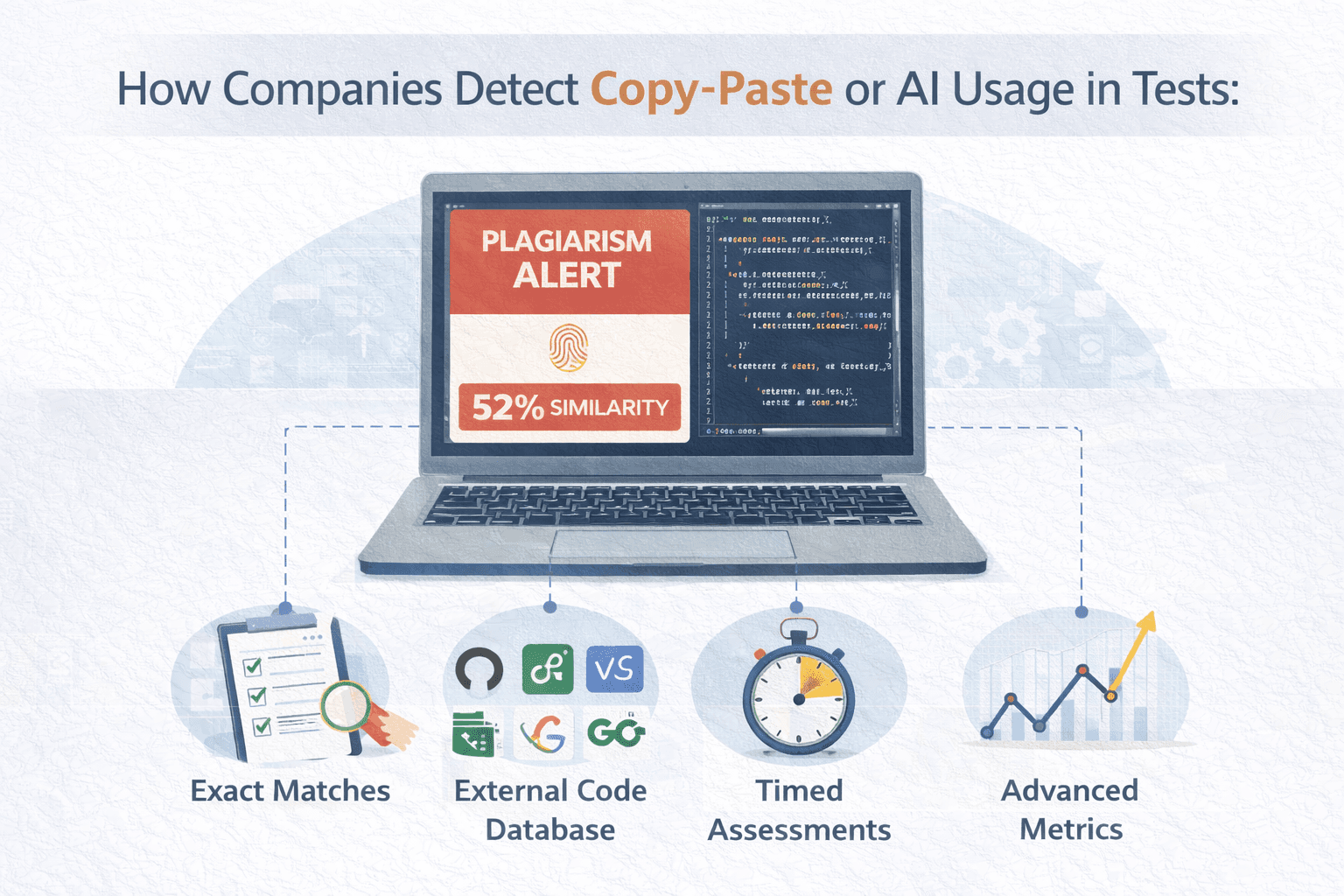
Online tests have become a standard part of campus and off-campus hiring in the Indian IT industry. With remote assessments and easy access to AI tools, companies now focus not only on what a candidate answers, but how the answer is produced. Many freshers believe small copy-paste actions or AI-generated responses go unnoticed. In reality, hiring platforms and interview processes are designed to detect such patterns. Understanding how companies evaluate test behavior helps freshers prepare honestly and perform with confidence.
Why companies are strict about this today
Online assessments are now common in campus placements, walk-in drives, and off-campus hiring. With remote tests and easy access to AI tools, companies have tightened their evaluation methods.
This is not about punishment. It is about trust and job readiness.
Companies want to know whether a fresher:
Understands fundamentals
Can think independently
Can perform under real work conditions
That is why detection systems exist—and they are more advanced than most freshers realize.

1. Plagiarism detection in coding tests
Most coding platforms used by Indian IT companies run plagiarism checks automatically.
How this works:
Code is compared with thousands of past submissions
Logic patterns, not just variable names, are matched
Similar structure = red flag
Even if you change variable names or formatting, logic similarity is detected.
👉 Reality check: Two candidates submitting near-identical logic rarely pass shortlisting.
2. Behavioral analysis during online tests
Many platforms track how you behave during the test, not just your answers.
They monitor:
Sudden long inactivity followed by full solutions
Copy-paste events
Switching tabs or windows repeatedly
Unusual typing patterns
These signals do not fail you instantly, but they lower trust scores.
3. AI-generated answer patterns
Companies are getting better at identifying answers produced using AI tools.
Common signs include:
Over-perfect explanations for basic questions
Inconsistent coding style within the same test
Advanced concepts used without basic understanding
Answers that do not match a fresher’s interview explanation
In follow-up interviews, candidates are often asked to explain their own answers. This is where AI-dependent candidates get exposed.
4. Webcam and proctoring systems
For many campus and large off-campus drives, remote proctoring is enabled.
These systems can:
Monitor eye movement and screen focus
Detect phone usage
Capture screen activity
Flag suspicious behavior for review
Even if no action is taken immediately, flagged profiles are reviewed manually.
5. Follow-up interviews (the biggest filter)
This is the most important detection method.
Interviewers check:
Can you explain your code step-by-step?
Why did you choose this approach?
Can you modify the solution live?
Candidates who rely heavily on copy-paste or AI tools usually struggle here, even if they cleared the test.
6. Why copy-paste hurts freshers more than seniors
Senior professionals are evaluated on experience and decision-making. Freshers are evaluated on learning ability and honesty.
When a fresher uses shortcuts:
Skill gaps become obvious later
Interview confidence drops
Trust is lost early
Companies prefer a candidate who scores slightly lower but shows genuine thinking.
What companies actually expect from freshers
Companies do not expect perfect answers.
They expect:
Basic correctness
Clear thinking
Honest attempts
Willingness to learn
Using AI tools for learning and practice is fine. Using them to fake skills in tests is risky.
How to stay safe and job-ready
Follow these simple rules:
Use AI tools to understand concepts, not to copy answers
Practice writing solutions on your own
Learn to explain what you write
Focus on fundamentals, not shortcuts
This approach works for both campus and off-campus hiring.
Final takeaway
Companies are not trying to trap freshers. They are trying to find genuine talent. Copy-paste or blind AI usage may help once, but it hurts long-term careers.
Join WhatsApp Groups for Job Updates
Group 1: CLICK HERE> https://chat.whatsapp.com/KCxEwu33GbvEgwiE82BPhO
📢 Don’t forget to forward this message to your friends and help them kick-start their careers