Why Most Fresher Resumes Get Rejected in 7 Seconds
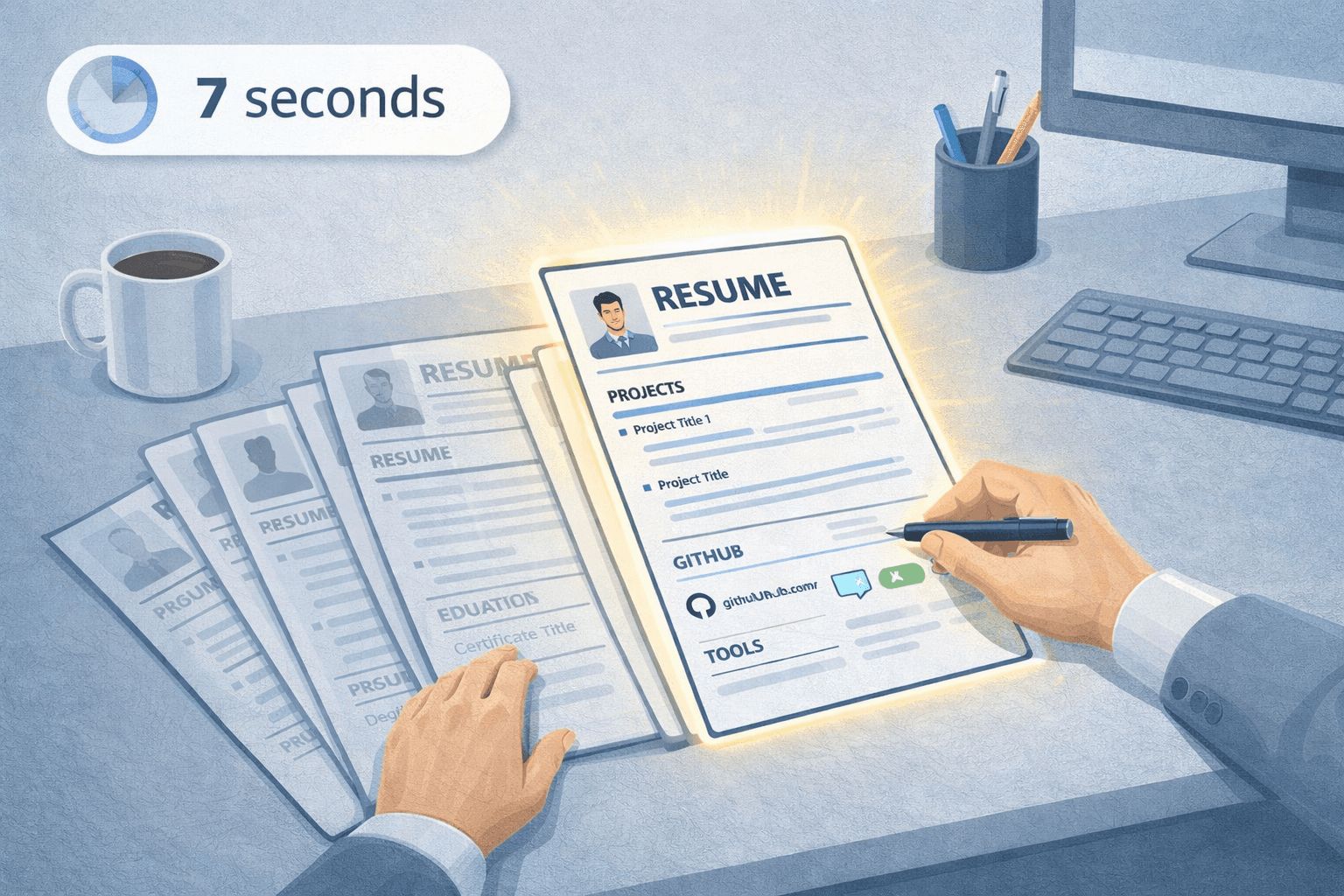
Recruiters don’t spend minutes reading fresher resumes. They scan them. And that scan usually lasts 6–7 seconds. This is not a myth. Eye-tracking studies by hiring platforms show recruiters make a yes/no decision almost instantly. For freshers, this first impression decides everything.
So why do most fresher resumes fail in those 7 seconds?
Let’s break it down clearly and practically.
1. The Resume Looks Crowded and Confusing
The first thing a recruiter checks is layout clarity, not skills.
Common fresher mistakes:
Dense paragraphs
No white space
Too many fonts or colors
Important details buried in text
In 7 seconds, recruiters ask: “Can I quickly understand this profile?”
If the answer is no, the resume is rejected—even if the candidate is capable.
Reality: A clean, readable resume beats a long, information-heavy one.
2. No Clear Role Targeted
Most fresher resumes are generic.
They list:
Java
Python
SQL
HTML
Cloud
AI
But they don’t answer one basic question: “What role is this candidate applying for?”
Recruiters hire for specific roles, not “IT fresher”.
If your resume doesn’t clearly say:
Software Developer or
QA Engineer or
Data Analyst or
Cloud Support
…it gets rejected quickly.
Reality: A resume without a clear role looks unfocused.
3. Education Overload, Skill Undersell
Freshers often write:
College details in 8–10 lines
Marks, boards, semesters
Generic coursework
But recruiters already expect a degree. They scan instead for:
What you can do
What you’ve built
What you’ve worked on
If projects and skills are missing or weak, the resume doesn’t survive the scan.
Reality: Degrees make you eligible. Skills make you selectable.
4. Projects Are Missing or Sound Fake
This is one of the biggest rejection reasons.
Examples recruiters see daily:
“Mini project on management system”
“Final year project using Java”
No GitHub
No explanation of what was built
Recruiters know the difference between:
A copied academic project
A real, hands-on project
If your resume doesn’t show practical exposure, it’s rejected fast.
Reality: No real projects = no proof of ability.
5. Long Skill Lists with No Evidence
Many fresher resumes list 15–20 tools. Recruiters don’t believe such lists unless they see:
Project usage
Internship experience
GitHub links
Tool-specific outcomes
If skills look exaggerated or unsupported, rejection is instant.
Reality: 5 proven skills > 20 unproven skills.
6. No Keywords Recruiters Scan For
Recruiters don’t read resumes line by line. They scan for keywords, such as:
REST API
SQL queries
Automation testing
Data cleaning
Cloud basics
Version control (Git)
If these keywords are missing—or buried—the resume gets skipped.
Reality: Even a good resume fails if it’s not scan-friendly.
7. Resume Doesn’t Look “Job-Ready”
This is the final filter where recruiters subconsciously ask: “Can this person start contributing with training?”
Resumes that focus only on:
Certificates
Theory
Self-rated skills
…don’t create confidence.
Resumes that show:
Projects
Practical tools
Structured learning
Internship or live exposure
…get shortlisted.
How to Fix This (Quick Checklist)
To survive the 7-second scan:
Keep the resume 1–2 pages max
Target one role
Highlight projects early
Prove skills with examples
Use clean formatting
Add GitHub or live work
Use role-relevant keywords