Why Comparison Slows Career Progress
It usually starts quietly.
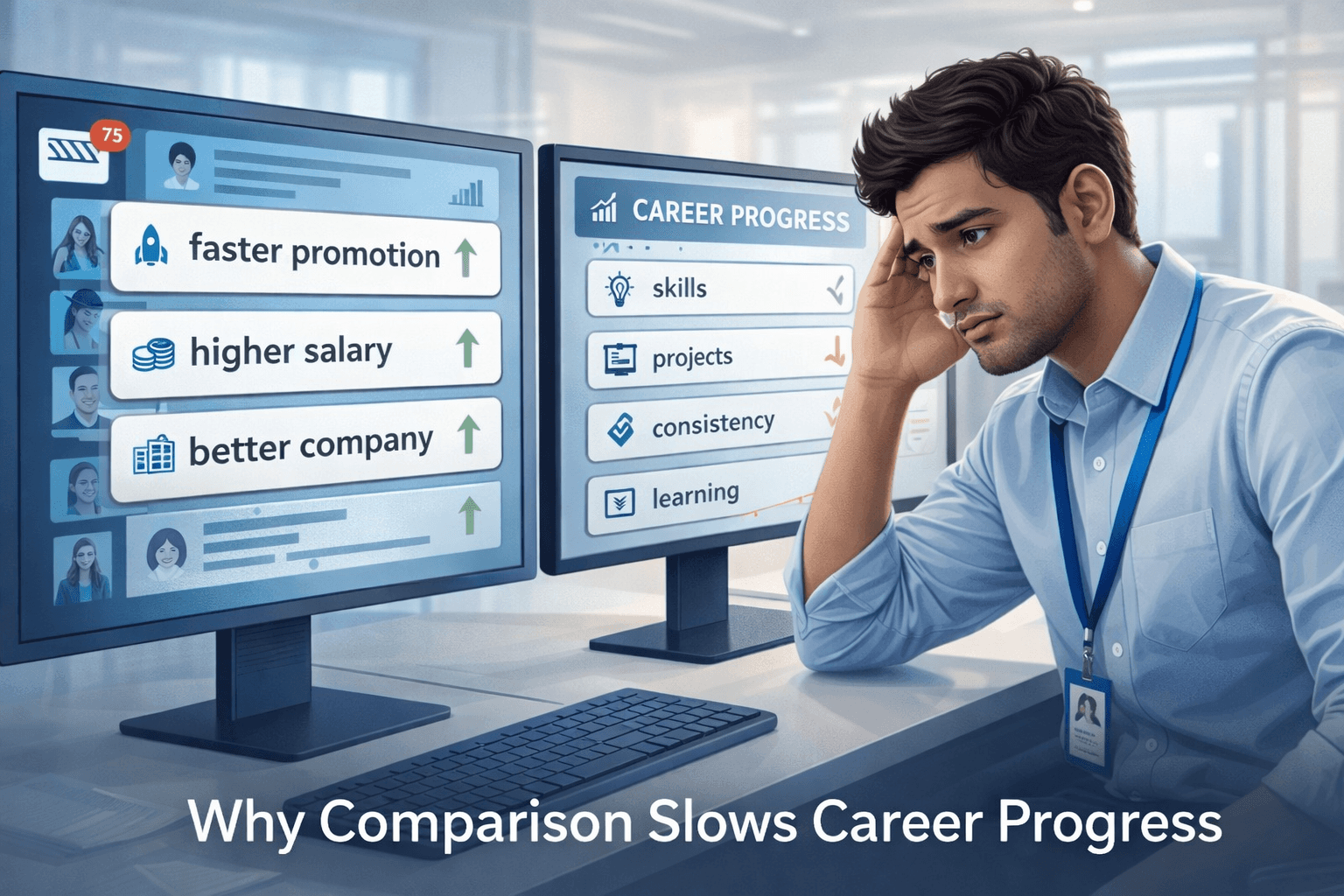
A fresher opens LinkedIn and sees a college friend posting a new job offer. Someone else shares a certification badge. Another person uploads a picture from a big company office. Slowly, a simple thought enters the mind: “Am I falling behind?”
This is one of the most common career traps for engineering graduates and IT freshers in India. Not because comparison feels dramatic, but because it feels normal.
In the early stage of an IT career, comparison often looks harmless. But over time, it steals focus, weakens confidence, and slows real progress. While one fresher is building skills, another is spending energy measuring their journey against everyone else’s highlight reel.
Why Freshers Compare So Much
The answer is simple. Early careers are full of uncertainty.
Freshers are trying to understand which programming language to learn, which role to choose, how much salary matters, whether certifications are enough, and how quickly they should grow. In this phase, it is easy to use other people as a benchmark.
One student gets placed early but struggles on the job. Another gets delayed but builds stronger practical skills. One starts in support and moves into development later. Another joins a brand-name company but does repetitive work with little learning.
This is why career comparison is often based on incomplete information.
How Comparison Slows Career Progress

1. It Shifts Focus From Skill Building to Image Watching
The biggest loss is focus. Instead of improving coding, communication, testing skills, working on projects, or preparing for interviews, many freshers spend time tracking what others are doing, comparing salaries, company brands, interview calls, and social media updates. However, in the IT industry, long-term growth comes from skill-based learning and real performance, not from constantly watching someone else’s journey.
2. It Creates Panic Decisions
Comparison often leads to rushed choices.
A fresher may suddenly switch focus from Java to Python, from testing to cloud, or from one certification to another just because someone else seems ahead. These decisions are often not based on career fit, but on fear.
This creates scattered learning.
And scattered learning slows career growth because the fresher never goes deep enough in one direction to become job-ready.
3. It Reduces Confidence
Once comparison becomes a habit, even genuine progress starts feeling small.
A student who has improved communication, completed projects, and become better at problem-solving may still feel unsuccessful because another person got placed first. This weakens motivation and creates unnecessary self-doubt.
In real IT work, confidence matters. Freshers need confidence to learn tools, ask questions, present ideas, and handle feedback. Constant comparison quietly damages that confidence.
4. It Ignores Different Starting Points
Not every fresher starts from the same point. Some have strong college exposure, mentorship, internships, or solid project guidance, while others come from colleges with limited placement support and have to build everything from scratch. That’s why comparing progress without understanding individual backgrounds is both unfair and unhelpful.
What Actually Helps Career Growth
Focus on Your Learning Curve
The strongest freshers are not always the fastest starters. They are often the most consistent learners.
If you improve your technical basics, communication, practical projects, and problem-solving week by week, you are moving in the right direction.
Build Real Job-Ready Skills
Recruiters and companies look for people who can contribute. That means practical understanding matters more than comparison.
Work on projects. Improve your fundamentals. Learn how software teams work. Understand testing, debugging, version control, and structured task execution. This is what creates real value in the hiring ecosystem.
Use Others for Direction, Not Pressure
There is nothing wrong with learning from your colleagues. The problem begins when inspiration turns into insecurity.
Observe what others are doing well. Maybe someone is consistent with projects. Someone else communicates clearly. Another person prepares smartly for interviews. Learn from that. But do not treat another person’s timeline as a rule for your own life.
Why Structured Learning Helps
Many freshers compare more when they lack direction.
A structured learning path reduces this confusion. When students follow industry-oriented training, practical projects, and guided skill development, they spend less time worrying and more time progressing.
Conclusion
Comparison slows career progress because it pulls attention away from the only thing that truly builds an IT career: consistent learning.
For engineering graduates, IT freshers, and interns, the smarter path is to focus on skills, practical exposure, project quality, and steady improvement. Someone else’s job update is not your career roadmap.
Your growth becomes stronger when your energy goes into learning, not comparing.
And in the long run, the freshers who keep building quietly are often the ones who move ahead with confidence, clarity, and real career success.
Join WhatsApp Groups for Job Updates
Group 1: CLICK HERE> https://chat.whatsapp.com/KCxEwu33GbvEgwiE82BPhO
📢 Don’t forget to forward this message to your friends and help them kick-start their careers