Learning Industry Tools vs College Tools
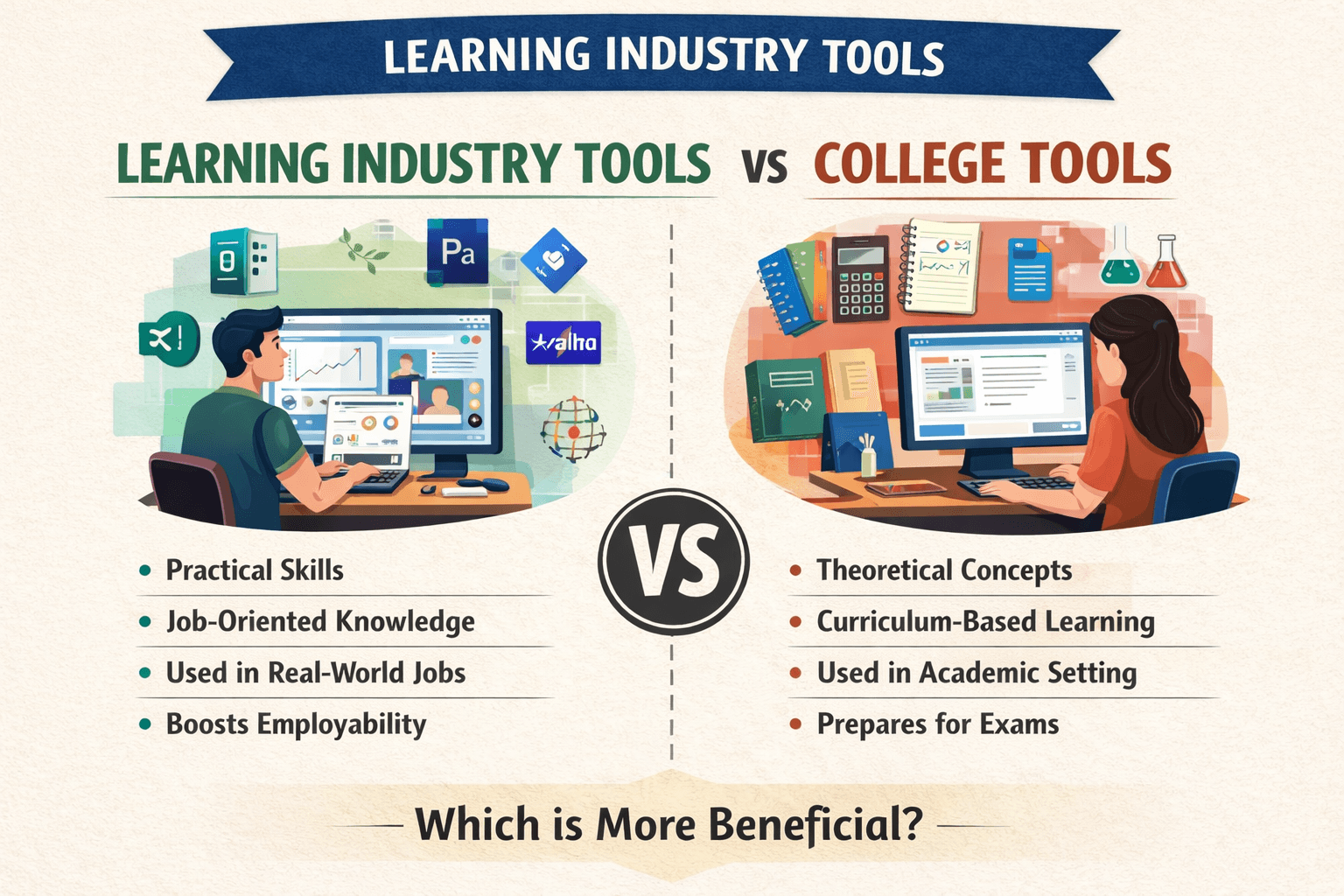
Many IT freshers complete their degrees with good marks but still feel unprepared for their first job. One major reason is the difference between college tools and industry tools.
In colleges, students mainly use basic software to understand concepts. In the IT industry, professionals work with advanced tools designed for real users, large systems, and team collaboration.
Understanding this gap early helps freshers prepare better, learn the right skills, and transition smoothly from classroom learning to real-world IT work.
Let’s break this down simply and realistically.

What Are “College Tools”?
College tools are mainly used for learning concepts, not for real production work.
Typical examples:
Basic IDEs (older versions)
Simple databases (local MySQL / SQLite)
Standalone programs
Manual testing or small scripts
One-person projects with no collaboration
These tools are good for fundamentals, but they are limited.
👉 Colleges focus on what happens, not how it works at scale.
What Are “Industry Tools”?
Industry tools are used in real companies to build, test, deploy, and maintain systems.
Common industry tools include:
Git & GitHub / GitLab (version control)
Jira / ServiceNow (tickets & workflow)
Cloud platforms (AWS, Azure basics)
CI/CD tools (Jenkins, GitHub Actions)
Logging & monitoring tools
Collaboration tools (Slack, Teams)
Automated testing frameworks
These tools handle:
Large codebases
Multiple developers
Real users
Real failures
👉 Industry tools focus on reliability, collaboration, and scale.
Key Differences That Matter to Employers
Area | College Tools | Industry Tools |
Purpose | Learning concepts | Solving real problems |
Scale | Small, local | Large, distributed |
Errors | Ignored or minor | Tracked & fixed |
Teamwork | Mostly individual | Fully collaborative |
Exposure | Limited | Production-grade |
This is why companies say: “You know theory, but you need training.”
Why This Gap Hurts Freshers
Freshers often struggle with:
Reading existing code
Using Git properly
Following tickets & workflows
Debugging real issues
Understanding deployments
It’s not because they are weak.
It’s because college never showed this environment.
The Right Way to Bridge the Gap
You don’t need to forget the basics but simultaneously add industry exposure on top of them.
Start with:
Use Git for every project
Work on small team-based projects
Learn basic cloud concepts (not certification-heavy)
Practice debugging instead of rewriting code
Follow real workflows (issues → fix → review)
Final Takeaway
College tools teach you how things work
Industry tools teach you how work actually happens
To become job-ready, you need both. Learn the basics well and then learn the tools companies actually use. That combination makes a fresher confident, useful, and employable.
Join WhatsApp Groups for Job Updates
Group 1: CLICK HERE> https://chat.whatsapp.com/KCxEwu33GbvEgwiE82BPhO
📢 Don’t forget to forward this message to your friends and help them kick-start their careers